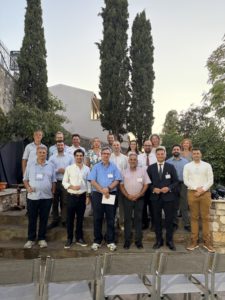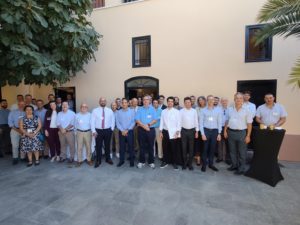
The Department of Economics of the National and Kapodistrian University of Athens had the honor of hosting the international conference "Growth Drivers for the Greek Economy: Resilience, Inclusiveness, and Structural Transformation", which took place on Friday, September 11, 2026 at the History Museum of the University of Athens, in Plaka.
The conference was organized by the Department's International Economics and Development Laboratory (IEDL), in collaboration with the Hellenic Observatory of the London School of Economics and Political Science, and brought together 53 participants from 17 universities and leading institutions, around a question of national importance: what is driving economic growth in Greece today, after a decade of economic adjustment.
The range of institutions that participated is remarkable in itself. From Greek universities – the National University of Athens and its Department of Economics, the Athens University of Economics and Business, the Agricultural University of Athens, the National Technical University of Athens, the Panteion University of Social and Political Sciences, the Aristotle University of Thessaloniki and the Universities of Patras, Piraeus, Thessaly and Macedonia. From abroad – the LSE, Birkbeck, King's College London, the Universities of Glasgow, Essex and Antwerp, as well as UCD's Smurfit Graduate Business School. In addition, representatives from the Bank of Greece, the European Central Bank, the European Stability Mechanism (ESM), the European Commission, the European Bank for Reconstruction and Development (EBRD), the Organization for Economic Cooperation and Development (OECD), KEPE, IOBE, diaNEOsis, the State Budget Office in Parliament and the Ministry of National Economy and Finance participated.
The work was organized into four thematic sessions, which together constituted a comprehensive reading of the challenges of the Greek economy. The first focused on the labor market, human capital and social cohesion, shedding light on how household choices, unemployment protection and access to housing shape participation and cohesion. The second focused on fiscal frameworks, debt dynamics and public investment, examining the conditions for fiscal stability and sustainable financing of growth. The third examined productivity, innovation and industrial policy, as critical drivers of structural transformation and convergence. The fourth raised the emerging challenges of institutional adequacy and state capacity, highlighting the role of governance in the transition from recovery to sustainable growth. This thematic structure allowed the discussion to move from the microeconomic dimensions of employment and households to the macroeconomic and institutional issues that determine the country's long-term development prospects.
A special place in the conference program was occupied by the keynote speech by the Ambassador and Permanent Representative of Greece to the OECD, Professor George Pagoulatos, who, drawing on Greek and international experience, highlighted the dimensions of political economy in the formation of economic policy and the promotion of reforms.
The contribution of the faculty members of the Department of Economics was decisive. The responsibility for the organization was held by Professor Antonis Bartzokas, Director of the Department's International Economics and Development Laboratory (organizer, opening notes and conclusions), and Assistant Professor Pantelis Kostis (organizer and session discussant). Also participating in the work were Professor Georgia Kaplanoglou and Professor Andreas Papandreou (session chairs), Associate Professor Frango Kouranti and Assistant Professor Christos Pierros (session discussants), as well as Assistant Professor Vasiliki Dimakopoulou (paper author).
The full program and all papers are available on the IEDL website: https://iedl.econ.uoa.gr/growth_drivers_for_the_greek_economy_conference
A collective volume will follow, which will be published by an international publishing house.
Photographic material from the conference: